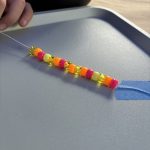
I have been thinking about patterns for a long time, occasionally making progress in understanding how children learn to identify and think about patterns.
Overall, it is slow going. There isn’t nearly as much of a research base on learning patterns as there is for learning about numbers or shapes. The one study I have found really useful makes clear that children are usually offered one of two types of pattern tasks:
Type A: Blue-red-blue-red-blue…what comes next?
Type B: Here is my pattern: Blue-red-blue-red-blue-red. Now use these blue and red chips to recreate my pattern.
In each of these task types, children can be successful without really engaging with the nature of the pattern, or what a pattern is.
In Type A, they can caught up in the alternating rhythm without analyzing the unit, and in Type B, they can match one bead at a time exactly as they would if there were no pattern. Learning about patterns requires engaging with their structure.
So these authors developed a new task type, and saw some success.
an insight
Type C: Here is my pattern: Blue-red-blue-red-blue-red. Here are some shapes. Use these shapes to recreate a pattern like mine.
To be successful here, a child needs to:
- Identify that there are two different elements that make up the pattern (red and blue)
- Select two different elements for their own pattern (e.g. triangle and square)
- Build a new pattern by either: (a) corresponding red to triangle and blue to square, or (b) building units of square-triangle to repeat.
All in all, Type C requires a lot more engagement with the pattern than Types A or B. Brilliant.
putting it into practice
Chris Nho (friend and Public Math colleague) and I have collaborated on a craft project that uses this insight as one of its pillars for math engagement.
Here’s the setup.


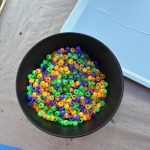

There are two key elements to the experience. The first introduces numbers; the second introduces the patterning research.
Key element 1: Numbers. The red, orange, yellow, green, and blue bracelets each have a number: 20, 25, 30, 35, and 40, respectively. We ask each child to try them on and report which one fits them best. We ask them to tell us what number is on the bracelet, and then tell them that’s how many beads they’ll need to make their bracelet.
Why this is key: Without this, children begin stringing beads. They rarely count or consider the size until it looks “long enough”. In general that’s not a bad thing. We are out here to support math learning, though. So let’s get those children counting with purpose. Let’s offer whatever support they need (from reading the number for the under-five set, to keeping count, or recounting when they spill, etc.)
Key element 2: Sample patterns. The black-and-white bracelets are abstractions of patterns children might make for themselves. Crucially, we do not offer black and white beads. Children see clearly patterned bracelets as the examples. We point them out and suggest they may inspire ideas. But we do not provide the materials to make the examples. We also do not require them to make one of these patterns.
Why this is key: The sample patterns in black and white set the tone (together with the invitation to “make a pattern bracelet”), while preventing direct imitation like a Type B task. We also do not begin your bracelet for you to continue (which would be a Type A task).
some additional considerations
What if kids want to make the example? It is not possible. After making hundreds of bracelets with children of many ages, I can report that fewer than five children have asked where they can get the black and white beads.
Color selection. I was initially concerned about kids spending tons of time digging through a bowl full of multicolored beads to find the ones they wanted to use. In the initial trials of this activity, we kept the colors separate. That worked well. And also Chris pushed back, saying it was unnecessary. So at one event we offered mixed colors. Chris was right. It was not a problem.
I still believe offering limited palettes makes sense (as you see in the bowls in the photos in this post), but I have let go of single-color bowls.
The setup. Here’s a link to our materials list. Get in touch if I can help you get anything started.
Some examples. Here are three sample bracelets from recent events. The third of these is particularly interesting. I asked the child making it whether black-black-black-black is a pattern, and then posed the same question to his father. They agreed it is not. I get their perspective, and also I disagree.